A single composite score compresses dozens of signals into one number. The compression is exactly what destroys trust, because the CSM can't trace the number back to a reason.
AI LAB · PROJECT 01
AI interprets evidence and communicates results. It does not own diagnostic authority.
An AI-assisted diagnostic system that evaluates whether a customer is achieving the outcomes that justified the purchase, identifies conditions that support or threaten those outcomes, exposes missing or contradictory evidence, and helps Customer Success teams decide what deserves attention next.
Every Customer Success team eventually builds, buys, or inherits a health score. Almost none of them trust it.
The pattern repeats across companies. A model outputs a number, usually red, yellow, or green, and the CSM who owns the account can't explain why it moved. The score can't say which evidence it used, whether that evidence was ever confirmed as true, or what would need to happen to change it. When the number and the CSM's own judgment disagree, the number loses, quietly, and the team goes back to spreadsheets and instinct.
That isn't a tooling failure. It's an authority failure. The system was asked to make a judgment call it had no way to justify.
The question this project set out to answer: can an AI-assisted system evaluate customer health in a way a CSM or executive would actually trust, meaning it shows its evidence, admits what it doesn't know, and never quietly overrides a human's read of the account?
Before writing a line of methodology, the starting question was why existing health scores fail to earn trust, not how to build a better scoring formula. Three recurring failure patterns showed up across the approaches reviewed.
A single composite score compresses dozens of signals into one number. The compression is exactly what destroys trust, because the CSM can't trace the number back to a reason.
Most scoring models treat every input as equally certain. A rumor from one email thread and a confirmed contract renewal get averaged together as if they carried the same weight.
When evidence is missing or contradictory, most systems still produce a clean number rather than admitting the gap. The output looks decisive right up until it's wrong.
A health diagnostic earns trust by being auditable, not by being smart.
The central design decision followed directly from that hypothesis: separate the parts of the system that interpret language from the part that decides the outcome.
Large language models are genuinely good at reading messy customer evidence, emails, call notes, tickets, and pulling structured signal out of it. They are not something you want holding sole authority over a governed business conclusion, because they can be persuasive and wrong at the same time.
So the system was split into two categories of work that never blend: interpretation work, which stays AI-assisted, and authority work, which stays rules-based and deterministic. A human confirmation step sits between the two, deliberately. Nothing the AI extracts from evidence is allowed to affect the governed result until a person has confirmed it.
The 5-step method
Evidence moves through five stages, and only one of them is allowed to decide anything.
Notes, emails, call summaries: whatever a CSM already has on the account.
The evidence is parsed into structured candidates, such as stakeholder changes, service issues, and risk signals, each traceable back to the exact source text it came from.
A reviewer confirms, corrects, or rejects each candidate before it can affect anything downstream. Nothing consequential moves forward on AI say-so alone.
A fixed, published methodology, not a model and not a prompt, evaluates the confirmed evidence and produces the diagnostic result: objective outcome, risk exposure, operational priority, and an explicit account of what remains uncertain.
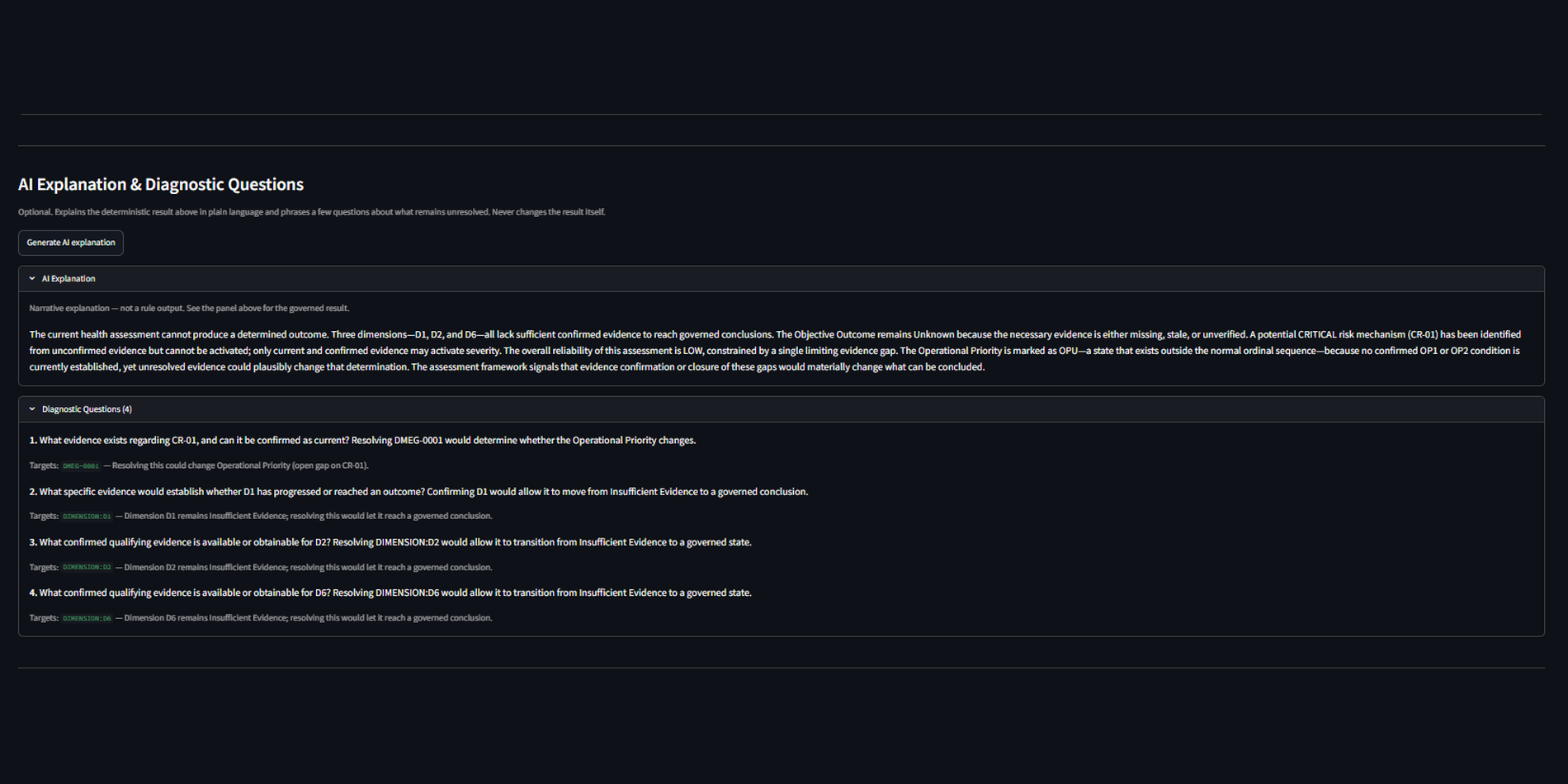
The AI is invited back in, only to explain the governed result in plain language and phrase a handful of questions about what's still unresolved. It cannot introduce a fact, a risk, or a conclusion that isn't already in the governed result.
AI interprets evidence and communicates results. It does not own diagnostic authority.
That boundary is enforced at two separate points, not just asserted in a slide. At extraction, every AI-proposed candidate is inert until a human confirms it; the rules engine only ever reads confirmed evidence. At explanation, the AI is handed a closed package of already-governed facts and unresolved-gap references, nothing else, and its response is checked against that package before anything reaches the screen. If the explanation references anything outside that package, it doesn't get shown; the underlying diagnostic result is displayed on its own instead.
The AI can be wrong about how it phrases something, and the worst case is a plain notice that the explanation isn't available. It cannot be wrong about the diagnosis itself, because it never gets a vote on the diagnosis.
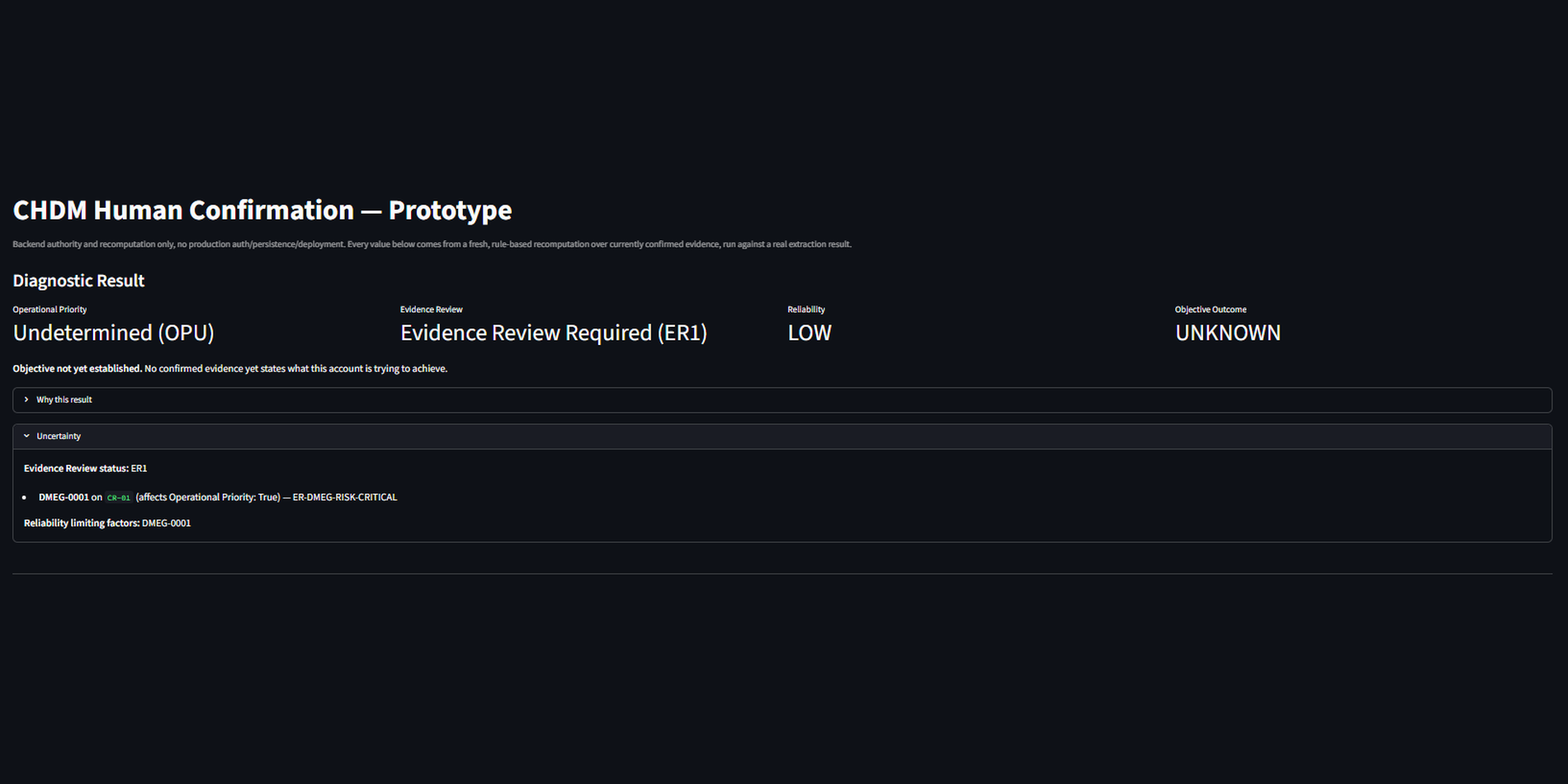
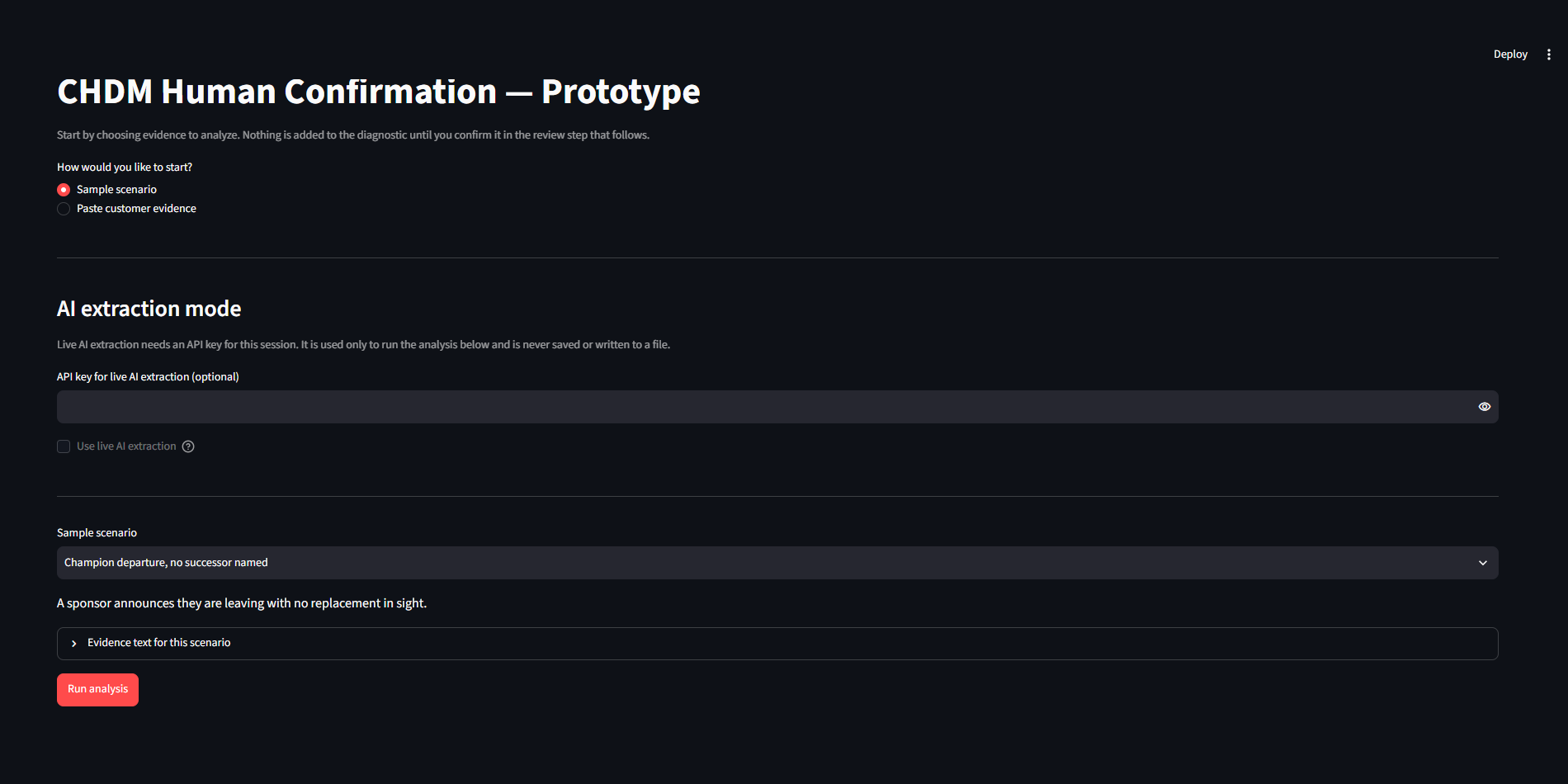
A working prototype exists: a Streamlit application that walks a reviewer through the full flow end to end, from raw evidence to a governed result to an AI explanation. The screenshots below are from that running app. Try it yourself with the flagship scenario, or read the code directly.
The system was validated in layers, moving from synthetic to live at each stage.
A system built on "admit what you don't know" should hold itself to the same standard.
The technical challenge in this project turned out to be the easy part. Getting a language model to extract structured signal from messy text, or to phrase a coherent explanation, is now a solved problem in most domains that matter.
The harder problem, and the one worth carrying into any future AI system, was deciding where the AI's voice should stop and a rule, or a human, should start. It's tempting to let a capable model handle the whole judgment end to end, because it can. The discipline is in refusing that shortcut deliberately: writing down, in advance, exactly which decisions the AI is never allowed to make on its own, and then building the software so that boundary can't quietly erode as the system grows.
That isn't really an AI lesson. It's an operations lesson wearing an AI costume: authority has to be designed, not assumed, or it drifts to whichever part of the system is most persuasive rather than whichever part is most accountable.
Authority has to be designed, not assumed.
LET'S TALK ABOUT WHAT THIS COULD MEAN FOR YOUR TEAM